Why Flashing Is the Most Common Source of Roof Leaks in South Florida in Tamarac
If you have experienced a roof leak in Tamarac and had a contractor investigate it, there is a reasonable chance the source was flashing. Flashing, the metal or membrane material that seals the points where two different roofing surfaces meet or where the roof surface is interrupted by a penetration, is consistently the most common source of residential roof leaks in South Florida. Understanding why flashing fails in this climate, where it is most vulnerable, and what a proper repair looks like helps Tamarac homeowners ask better questions and make more informed decisions when a leak appears.
What Flashing Does and Why It Matters
Roofing surfaces like tile, shingles, and flat membranes are designed to shed water over their main field areas. But every roof has points where the surface is interrupted or where two different materials meet, and those transition points cannot be sealed by the roofing material itself. That is where flashing comes in. Flashing seals chimneys, skylights, vent pipes, plumbing penetrations, the bases of walls that rise above the roof surface, and the valleys where two roof planes meet.
In a properly installed roofing system, flashing and the sealants associated with it are the last line of defense at these vulnerable transition points. When flashing fails, those points become direct water entry locations. And because water entering at a flashing failure travels along the roof deck, framing, or wall cavities before it shows up as a ceiling stain, flashing failures often produce interior damage that appears nowhere near the actual entry point.
Why Flashing Fails Faster in Tamarac’s Climate
Flashing relies on two components: the metal or membrane material itself, and the sealants that fill gaps and bond it to adjacent surfaces. Both are adversely affected by South Florida’s climate in ways that shorten their effective service life compared to cooler markets.
Sealants, including roofing caulks, butyl tape, and rubberized coatings, undergo thermal cycling with every daily temperature swing. They expand when hot and contract when cool, and after years of this cycle, they crack, shrink, and separate from the surfaces they were bonded to. In Tamarac, where summer afternoons regularly push roof surface temperatures well above 150 degrees, and the climate provides no relief from this cycle year-round, sealant degradation happens faster than product labeling typically suggests.
Metal flashing, particularly galvanized steel, is susceptible to corrosion in South Florida’s high-humidity environment. Aluminum flashing resists corrosion better but is subject to expansion and contraction stress that can fatigue sealants at its edges over time. In Tamarac’s inland location, salt air is not the primary factor that it would be for coastal communities, but the heat and humidity alone are sufficient to shorten the service life of both sealants and metal components relative to national averages.
The Most Common Flashing Failure Points on Tamarac Homes
Pipe boots are the rubber collars that seal plumbing vents through the roof surface. They are exposed to direct UV radiation throughout their service life and typically become cracked, shrunken, or brittle within 10 to 15 years in South Florida’s UV environment. A failed pipe boot creates a direct opening around the vent pipe that allows wind-driven rain to enter the roofing system.
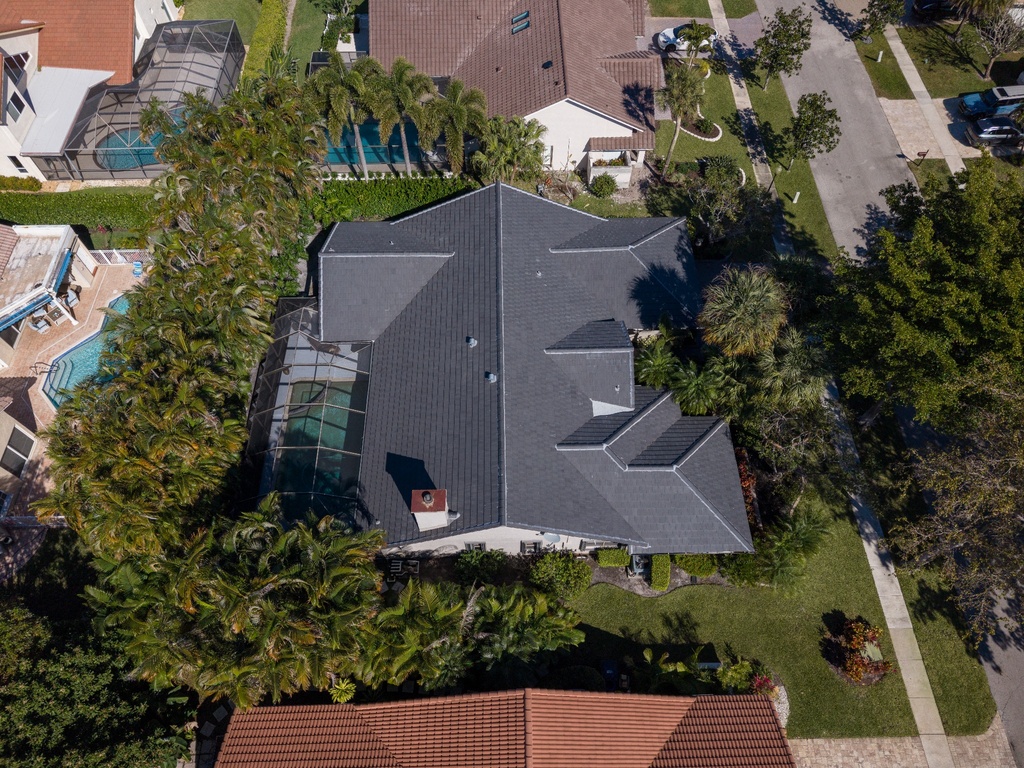
Chimney and skylight flashing involves multiple pieces of metal overlapping in a step pattern up the sides and along the top and bottom of the chimney or skylight frame. Each overlap relies on sealant to remain watertight. When the sealant at any overlap or at the flashing’s termination edge fails, water enters at that point and travels. Chimney and skylight leaks are among the most difficult to trace accurately because the water entry point and the visible interior damage can be far apart.
Wall flashing at the base of parapet walls, at second-story walls that extend through the roof plane, and at the transition between the roof surface and an exterior vertical wall is another frequent failure point. This flashing often uses a combination of metal and sealant that must accommodate the different expansion rates of the wall and roofing materials. When the sealant at these transitions fails, wind-driven rain can drive water behind the roofing surface and into the wall cavity.
What Proper Flashing Repair Looks Like
A proper flashing repair does not simply involve applying additional sealant over failed sealant. In many cases, the failed material must be removed, the substrate cleaned and prepared, and new flashing or new sealant installed in a way that addresses the underlying failure mode rather than just covering it. In Florida’s HVHZ, flashing repairs must use materials with Florida Product Approvals and must be performed by a licensed contractor.
A contractor who applies caulk over failed flashing without addressing the preparation of the substrate or the adequacy of the new material is performing a temporary patch rather than a durable repair. Ask your contractor specifically what the repair involves and what material they are using before the work is done.
Frequently Asked Questions
How do I know if my roof leak is from flashing failure?
Flashing failures tend to produce leaks that appear during wind-driven rain rather than during straight-down rainfall, because the failure point only allows water entry when rain is pushed at the angle that exposes it. Leaks that appear near chimneys, skylights, vent pipes, or exterior walls, even when those locations are not directly above the interior stain, are commonly associated with flashing failures. A professional assessment will identify the actual entry point.
How long does roof flashing typically last in Tamarac?
Metal flashing itself, when properly installed, can last 20 or more years. The sealants that make flashing watertight have a shorter service life in South Florida’s climate, typically 10 to 15 years before they crack or separate. This means that flashing maintenance, including inspection and sealant touch-up, should be part of a regular roof maintenance program even when the metal itself is in good condition.
Can flashing be repaired without replacing the entire roof?
Yes, in most cases. Flashing repairs are typically targeted work that does not require removal of the broader roofing system. The exception is when flashing failures have allowed water to reach the underlayment or deck in a way that has caused deterioration requiring more extensive work. A professional assessment will clarify whether the flashing repair scope is straightforward or whether underlying damage needs to be addressed at the same time.
Should flashing be replaced when I get a new roof?
Yes. A full roof replacement is the appropriate time to replace all flashing components, since the existing flashing must be removed to properly install the new roofing system. Attempting to reuse old flashing during a replacement adds risk because the reused components may already be approaching the end of their useful life and will require attention again before the new roof does.
What type of flashing material is best for South Florida homes?
Aluminum flashing is commonly used in South Florida for its corrosion resistance, which is relevant even in inland communities like Tamarac, given the humidity levels. Copper flashing offers superior longevity and corrosion resistance, but at a higher cost. The appropriate choice depends on the application and the roofing system type. Your contractor should specify the material they intend to use and confirm it carries the required Florida Product Approvals for the application.
SK Quality Roofing has been serving South Florida homeowners since 1982, with more than 14,000 residential projects completed across Broward and Palm Beach County. For flashing repair and roof leak diagnosis in Tamarac, contact SK Quality Roofing at 561-276-8040.

Written by
Dante Weston
Owner at SK Quality Roofing, Dante Weston brings experience and expertise in residential and commercial roofing. He is passionate about helping homeowners and businesses protect their properties with quality roofing solutions and practical maintenance advice. Dante provides useful tips, guidance, and insights to help readers make informed decisions about roofing projects and upkeep.