Metal Roof Repair Palm Beach Gardens
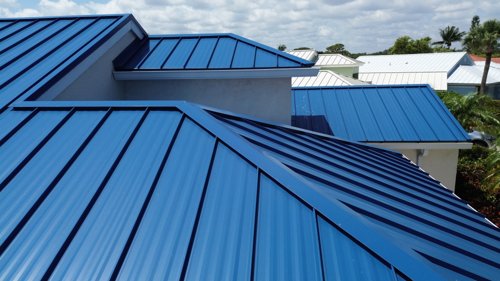
SK Quality Roofing is a dependable metal roof repair company serving Palm Beach Gardens homeowners whose metal roofs have started to leak, rattle, or show surface rust. Metal is a minority roof in this city — concrete tile dominates the big golf communities — but where metal does appear, along the Intracoastal Waterway on the eastern edge and on newer homes in Alton, it tends to be a deliberate, long-term choice by the owner. A roof chosen for a multi-decade service life deserves repair work that protects that investment rather than patching the symptom and leaving the cause in place.
That is the standard owner Dante Weston sets for every repair call. Because Dante has spent his career matching materials to exposure, he insists a metal roof near salt-laden air in Frenchman’s Creek gets evaluated differently from one under the heavier tree canopy inland near Dyer Park — the corrosion pressure, debris load, and moisture patterns are simply not the same. General manager Robert Brady brings the field half of that judgment: what he actually sees when panels come up, from backed-out fasteners to sealant that failed years before the stain showed on the ceiling. Call (561) 276-8040 to schedule a free inspection and a free estimate, and you will get findings in writing before any work is proposed.
SK Quality Roofing is family-owned, has served South Florida since 1982, and has looked after more than 14,000 customers across four decades. Crews reach Palm Beach Gardens from our Delray Beach headquarters, and the company’s repair-first philosophy applies on every visit: if a targeted repair restores the system, that is the recommendation. A replacement is raised only when the inspection shows repair would be money spent delaying the inevitable — and when that is the honest answer, the team says so plainly and explains why.
Common Reasons Metal Roofs Need Repair

Metal roofs fail in predictable ways, and Palm Beach Gardens produces all of them. The most common starting point is the fasteners. Exposed-fastener systems depend on screws with rubber washers, and Florida heat cycles expand and contract the panels daily until screws back out, washers dry and crack, and each penetration becomes a small entry point for wind-driven rain. Robert Brady notes that homeowners rarely notice this stage at all — the roof still looks sound from the street in San Michele or along PGA Boulevard — which is exactly why a hands-on inspection matters more than a look from the driveway.
Loose fasteners and seam separation. Panels move as they heat and cool, and over years that movement works on seams as well as screws. Standing seam profiles can open at the joints, corrugated panels can lift at the laps, and once a seam separates, capillary action pulls water sideways into places it was never meant to reach. Homes near Legacy Place and Downtown Palm Beach Gardens with lower-slope metal sections are especially prone to this, because slow-draining water sits on the seam longer after every afternoon storm.
Rust and coating failure. On the city’s eastern side, the Intracoastal carries salt into the air year-round, and that salt settles on every metal surface in Frenchman’s Creek and the waterfront streets nearby. The factory coating is the roof’s only real defense; once it is scratched, chalked, or worn through at fastener points and panel edges, corrosion starts underneath and spreads out of sight. Inland roofs trade that problem for a different one — leaf litter and palm debris holding moisture against the surface around Dyer Park and the canopy streets off Northlake Boulevard, which keeps panels damp long after the rain stops.
Warped and storm-damaged panels. A panel that has been dented by a falling branch, walked on incorrectly, or lifted by storm winds rarely sits flat again. Warped panels break the drainage pattern of the whole slope, pond water where the profile should shed it, and stress the seams on either side. Dante Weston’s position is that a warped panel is never just cosmetic: because it changes how water moves across the roof, it has to be evaluated as part of the system, not in isolation.
These failure modes cut across all three profiles SK Quality Roofing repairs in Palm Beach Gardens — standing seam, metal shingles, and corrugated panels. Each profile fails in its own sequence, and the repair plan has to follow that sequence rather than applying one generic fix to every metal roof in the city.
Profile-specific patterns. Standing seam roofs hide their fasteners, so their repair calls usually start at the seams, the ridge, or the penetrations — vent stacks, skylight curbs, and the transitions where a porch roof ties into the main slope. Metal shingle systems fail more like the shingles they imitate: individual units crack, lift, or lose their interlock after impact, and the repair is a matter of weaving matched units back into the field without disturbing the courses around them. Corrugated panels, common on older homes, lanais, and outbuildings off Northlake Boulevard, show the classic exposed-fastener pattern first — screws backing out in a visible grid, rust blooming at the laps where water sits longest. There is also a cosmetic complaint that turns out to be diagnostic: rippling or oil-canning that worsens season by season often signals panels installed without room to expand, and Robert Brady treats that movement as information about the fastening pattern, not just an eyesore. Knowing which sequence a given roof is in is what separates a repair that holds for a decade from one that needs redoing after the next storm season.
Why Small Issues Should Not Be Ignored
The economics of metal roof repair reward speed. A backed-out fastener costs almost nothing to reseat and reseal. Left through one rainy season, that same opening can wet the underlayment across a wide area, rot the decking beneath a panel that still looks perfect from the ground, and turn a service visit into a partial rebuild. Robert Brady’s crews find this pattern constantly: the visible problem is a rust spot or a drip, but the real damage is hidden moisture intrusion that has been traveling under the panels, sometimes for years, because metal sheds surface water so well that leaks stay concealed longer than on other roof types.
Small issues also multiply each other. A separated seam lets water in; the water corrodes fasteners from below; the weakened fasteners let the panel move more; the movement opens the seam further. By the time a homeowner in Alton or Mirasol sees an interior stain, the repair scope often involves several panels, sections of underlayment, and deck repair that an earlier visit would have avoided entirely. This is why the company puts inspection findings in writing with photographs — so the homeowner can see the progression and make the timing decision with real information.
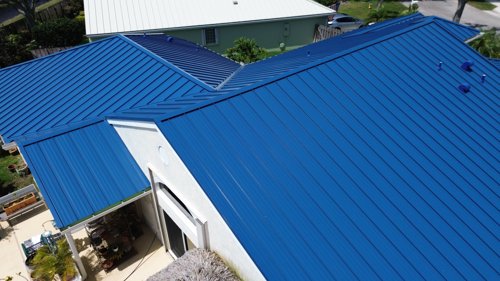
There is also a storm-readiness argument that matters in Palm Beach Gardens. A metal roof’s wind performance depends on every panel being fully engaged and every fastener holding. A roof that enters hurricane season with loose panels and open seams is not the roof its rating describes. Addressing the small items in the dry months — resealing, refastening, treating early corrosion — is what keeps the system’s rated performance real rather than theoretical. When an inspection instead shows that fasteners, seams, and panels are compromised across most slopes, the honest conversation changes: at that point, discussing metal roof replacement protects the homeowner better than another round of localized repairs.
Metal Roof Repair in Palm Beach Gardens: Quick Answers
The most common metal roof problems we see in Palm Beach Gardens, and the questions owners ask most.
| Problem | Common cause here | Usual repair |
|---|---|---|
| Rust at screws or fasteners | Salt air near the Intracoastal | Replace fasteners and washers with corrosion-resistant ones |
| Leak at a seam | Sealant aging under heat and sun | Clean, reseal or re-crimp the seam |
| Lifted panel edge | Wind uplift during a storm | Re-secure the panel and check its neighbors |
| Dents from debris | Storm debris or fallen limbs | Panel repair or replacement if the coating is broken |
Can I patch a metal roof myself?
We would not recommend it. Wet metal is slippery, and the wrong sealant or fastener can make corrosion worse. A professional repair matches the materials to your system.
Do metal roof repairs need to meet Florida code?
Yes. Repairs are governed by the Florida Building Code, and replacement parts should carry Florida Product Approval. We match approved materials to your existing panels.
When should I repair rather than replace a metal roof?
If the damage is limited to fasteners, seams or a few panels, repair is usually the right call. If corrosion has spread across most of the roof, replacement may be better. Hurricane season runs June 1 to November 30, per the National Hurricane Center, so it is worth deciding before then.
Extend Your Roof’s Lifespan Effectively with Metal Roof Repair
Every metal roof repair at SK Quality Roofing starts with a whole-system inspection, not a look at the one spot that leaked. The crew checks for hidden moisture intrusion beneath the panels, tests coating integrity across each slope, and assesses panel stability — how much movement the system has developed and where it is concentrated. Only after that full picture exists does the team build a targeted repair plan, so the work addresses causes in the right order instead of sealing over active corrosion or fastening into compromised decking.
Typical repairs include replacing damaged panels with matched material, resealing seams with products rated for the movement metal roofs experience, and securing or replacing fasteners with corrosion-resistant hardware. Where rust has started, the affected area is treated and recoated so the repair does not become the next failure point. Materials are matched for corrosion and UV resistance appropriate to the home’s exposure — a specification Dante Weston treats as non-negotiable east of the Intracoastal, where a mismatched repair alloy or a lesser coating can corrode faster than the original roof around it.
The repair visit also sets up the roof’s maintenance rhythm going forward. Homeowners receive a simple written schedule at close-out: a visual check from the ground after any major storm, a professional fastener-and-sealant review on a regular cycle, and prompt clearing of the debris that collects in valleys and behind chimneys on canopy lots. Sealants are consumables on a metal roof — they age out on a shorter clock than the panels they protect — and treating resealing as planned maintenance rather than an emergency is what keeps small numbers small. The company documents every repair with photographs of the areas opened and closed, so the next inspection, whether in two years or after a hurricane, starts from a record instead of a guess. For homeowners near The Gardens Mall and the busier PGA Boulevard corridor, that documentation also answers the questions associations and insurers increasingly ask about roof condition and upkeep.
The lifespan math is the reason to do this properly. A metal roof maintained at the fastener, seam, and coating level can serve for decades; the same roof ignored until panels perforate cannot be saved by any repair. Homeowners weighing repair against a broader roof replacement get that comparison in writing, with $0-down financing available if a larger project is the right call, and warranty coverage of 10+ years standing behind the company’s work. Florida license #CCC1336888, free inspections, and a repair-first recommendation are consistent on every Palm Beach Gardens visit.
If your metal roof is showing rust, loose panels, rattling in high wind, or a leak that only appears in hard rain, SK Quality Roofing can inspect the full system and tell you plainly what it needs. Call (561) 276-8040 for a free inspection and estimate, and extend the life of the roof you chose for the long term.
Owner at SK Quality Roofing, Dante Weston brings extensive experience in residential and commercial roofing. He is passionate about helping homeowners and businesses protect their properties with quality roofing solutions and practical maintenance advice. Dante provides useful tips, guidance, and insights to help readers make informed decisions about roofing projects and upkeep.